

Motor Vibration Monitoring: A Complete Guide to Predictive Maintenance
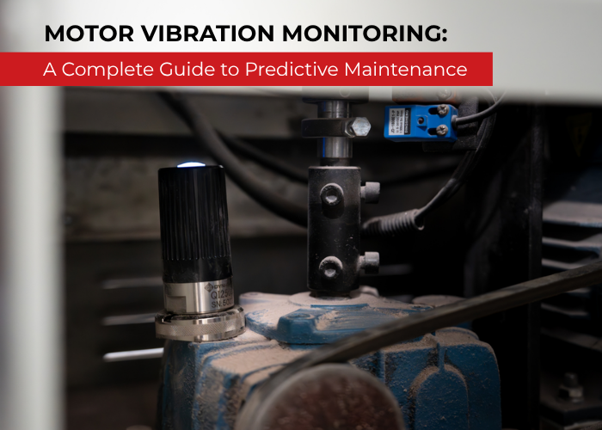
Motor vibration monitoring tracks changes in vibration, temperature, and frequency while a motor is running. It gives maintenance teams a clear view of machine condition over time. Instead of waiting for a serious problem, teams can spot changes, check the cause, and plan the right maintenance step.
What Is Motor Vibration Monitoring?
A motor can develop problems long before it stops working. Changes in vibration can give an early sign that something inside the machine is changing. The process uses a sensor to collect regular readings from the motor. These readings create a record of normal operation. Later results can then be compared with that starting point.
This approach is useful for:
- Electric motors from 5–200 HP
- Motors that run for long periods
- Equipment that is important to plant uptime
How Motor Vibration Monitoring Works
The process starts by choosing an important motor. A QI2500 Wireless Vibration & Temperature Sensor is then placed on the motor housing.
The sensor can use a magnetic mount on a flat or curved surface. A 1/4″-28 threaded mount can also be used for permanent installation.
After installation, the sensor records several types of data. The readings can be viewed through the sensor’s built-in Wi-Fi using a browser. Data can also be downloaded to a phone or PC.
No dedicated app, internet connection, or outside network is required.
What Motor Conditions Can Vibration Data Reveal?
Changes in machine movement can give useful clues about motor condition. The QI2500 supports checks for several mechanical problems.
These include:
- Imbalance and misalignment
- Mechanical looseness and bearing defects
- Wear, overheating, resonance, and rising vibration
FFT analysis and high-frequency acceleration can add more detail when checking bearing problems and other mechanical issues. A higher reading does not always mean the motor is about to fail. It shows that the change needs a closer look.
Key Measurements for Motor Monitoring
A motor should not be judged by one number alone. Several readings can be reviewed together.
| Measurement | What it tells the team |
|---|---|
| Vibration velocity RMS | Shows the overall vibration level |
| Acceleration | Shows high-frequency machine activity |
| Dominant frequency | Shows the main vibration frequency |
| Temperature | Shows another change in machine condition |
| FFT | Gives more detail about vibration frequencies |
The QI2500 measures vibration in three directions. It supports up to 375 mm/s RMS velocity and up to 60 g acceleration. Its frequency range is 0–16,000 Hz.
How to Establish a Motor Vibration Baseline
A baseline is a starting picture of how a motor normally runs. First, the team takes readings while the motor is operating normally. Later readings are compared with this starting point.
The process is straightforward:
Take the first reading → set the baseline → collect later readings → compare the results → investigate changes → plan maintenance
This gives each motor its own history.
For example, a QI Dynamics compressor case recorded a motor velocity RMS of 5.68 mm/s, a dominant frequency of 29 Hz, an acceleration RMS of 6.25 m/s², and a temperature of 70.9°F.
Those numbers describe that specific motor at that time. They are not universal limits for every motor.
How QI2500 Supports Motor Monitoring
The QI2500 is built for repeatable machine checks. It records vibration and temperature data and keeps the information locally.
Its industrial design includes an IP68 rating, a 304 stainless-steel base, coated internal electronics, and an operating range from -4°F to 140°F. Its CR123A battery typically lasts 1–2 years at the default 24-hour data interval.
The sensor can also be used on new equipment. A starting baseline can show whether a new motor is balanced, aligned, and running smoothly.
Monitoring Hard-to-Reach Motors with QI200
Some motors sit in places that are hard to reach again and again. The QI200 Remote Wireless Activation Switch works with the QI2500 and allows the sensor to be activated from a more convenient location.
This can reduce the need for:
- Ladders
- Long cables
- Repeated trips to difficult areas
It can also make data access easier without stopping normal production work.
Motor Vibration Monitoring vs. Periodic Checks
A handheld meter can give a useful reading during a visit. However, that reading is only a snapshot. With regular sensor data, maintenance teams can see how a motor changes over time. They can also keep past readings for comparison.
This creates a stronger history because the team can:
- Take repeatable readings
- Store past results
- Compare new readings with the baseline
- Watch the direction of a trend
Operator differences and long gaps between manual checks can make changes harder to track. Stored readings give the team more information to review.
Using Motor Trends to Plan Maintenance
A change in vibration should lead to investigation. First, review the trend. Then look at frequency, acceleration, and temperature to understand the change. In the Sullair compressor example, QI Dynamics set a yellow level of 6.5 mm/s and a red level of 8.0 mm/s for that specific motor.
A sustained 15% rise from its baseline was also a reason to inspect the motor. These figures were tied to that motor. The key point is to know the normal condition and watch for meaningful changes.
Why Use a Local Monitoring Setup?
For teams using vibration monitoring for motors, a large cloud system is not required. The QI2500 uses local Wi-Fi and browser access, with no required subscription, recurring fee, licensing fee, or internet connection.
Data stays local and can be downloaded directly. This setup keeps the focus on the machine. Maintenance teams can collect readings, review trends, and decide when an inspection is needed without a large IT rollout.
Take a Closer Look at Critical Motor Health
Good motor care starts with knowing what normal operation looks like. Vibration monitoring for motors gives maintenance teams a clear way to record condition, compare changes, and plan inspections.
QI Dynamics combines the QI2500 sensor with the QI200 remote switch for practical monitoring in industrial settings. Start with motors that matter most to uptime, create a baseline, and keep watching the trend.
FAQs
What does motor vibration monitoring measure?
It can measure vibration velocity, acceleration, dominant frequency, and temperature. These readings give maintenance teams more detail when checking changes in motor condition.
Why is a motor baseline important?
A baseline shows how a motor normally runs. Future readings can then be compared with it, making changes easier to spot and investigate.
What motor problems can vibration data show?
Vibration data can support checks for imbalance, misalignment, looseness, bearing defects, wear, overheating, resonance, and rising vibration levels.
Does the QI2500 need internet access?
No. The sensor uses its own Wi-Fi access point. Users can connect through a browser and download stored data directly to a phone or PC.
Recent Posts


